
Fig 1: Mug
to drink, to scoop, to serve.

Fig 2: Pail
to scoop, to serve, to drink.

Fig 3: Bowl
to serve, to drink to scoop.

A sentence and a non-sentence, distinguished by the spatial and temporal aspects of writing.

Marcel Duchamp, Fountain, 1917
A found object, renamed and repositioned, becomes something else. The object remains identical, but the context reframes what it is and how it is to be read. Showing it again, the gesture repeats: designation designates designation.
🖼 Stieglitz, Alfred (1917). Photograph of Marcel Duchamp's Fountain.
https://en.wikipedia.org/wiki/Fountain_%28Duchamp%29 (Accessed 03 Apr. 2026)
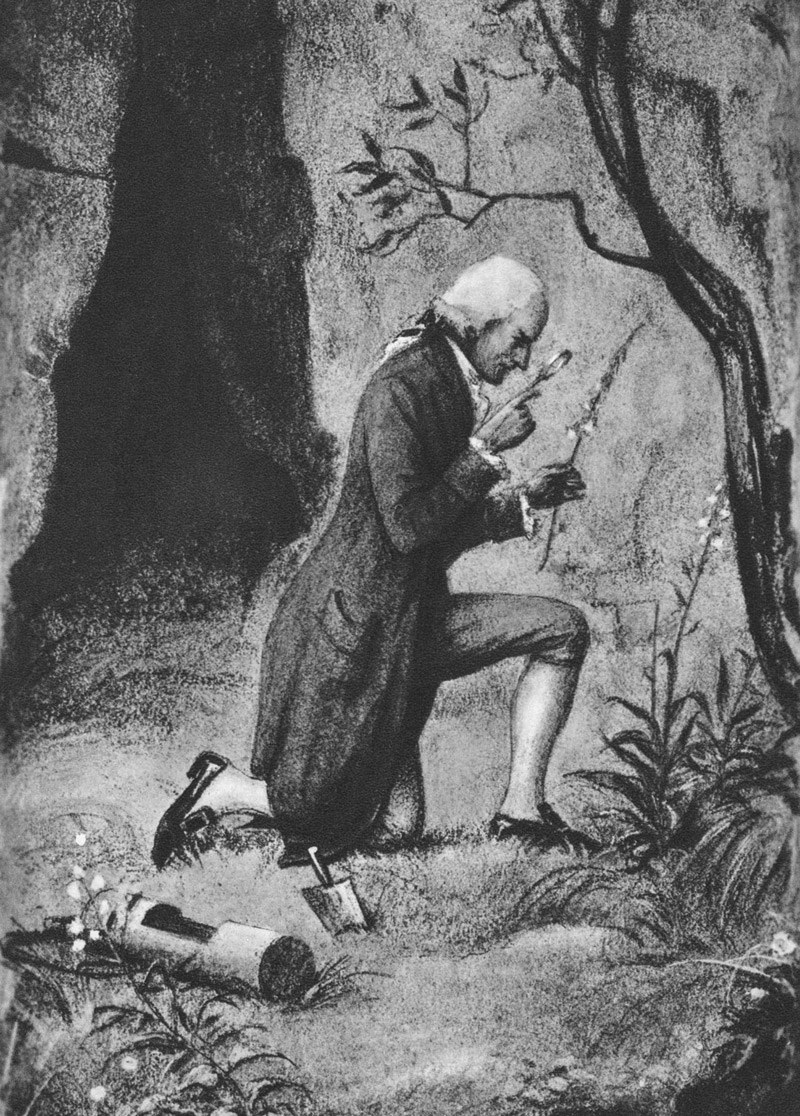
An observation of a man observing a plant, painted by someone observing him. Three designations, separated by time and distance. The scale changes, the operation does not.
🖼 Windelband, Wilhelm; Günther, Siegmund: Geschichte der antiken Naturwissenschaft und Philosophie. Nördlingen: C.H. Beck, 1888.

Colour & Grey Control Chart. Part Code BSTI, Batch #RANR2001
A gray card reflects eighteen percent of the light that falls on it, a value calibrated to correspond roughly to the midpoint of what human perception can distinguish. It serves as a reference point, an attempt to observe without generating meaning – a sign whose sole content is neutrality. But neutrality is also a convention, established by agreement and legible only within the system it belongs to.

Same meaning, different appearance
The Rosetta Stone became the key to deciphering Egyptian hieroglyphs, whose meaning had been lost for nearly fourteen centuries. Each sign system shapes the visible differently and organizes space, direction, and abstraction according to its own internal logic and conventions. What makes the stone legible, apart from its message, are the conditions under which a message becomes legible in the first place: that the same content, encoded in a different system, constitutes a different act of signification.
Height: 1123 mm, Width: 757 mm, Depth: 284 mm.
🖼 Jeff Dahl, 2009, https://commons.wikimedia.org/wiki/File:Rosetta_Stone_BW.jpeg

Picture of an ancient statue, cropped to an eye close-up.
In classic spaghetti westerns, the eye close-up is used to transport the audience into a character's inner world. It creates intimacy and reveals emotions that words can't express.
🖼 John, Karl; Dörig, José; Fuchs, Werner; Hirmer, Max: Die griechische Kunst. München: Hirmer Verlag, 1966.

Beim Doppelspaltexperiment treten kohärente Wellen, zum Beispiel Licht- oder Materiewellen, durch zwei schmale, parallele Spalte und werden auf einem Beobachtungsschirm aufgefangen, dessen Distanz zum Doppelspalt sehr viel größer ist als der Abstand der beiden Spalte. Durch Beugung der Wellenausbreitung am Doppelspalt entsteht ein Interferenzmuster. Bei Wellen mit einheitlicher Wellenlänge, z. B. beim monochromatischen Licht eines Lasers, besteht das Muster auf dem Schirm aus abwechselnd hellen und dunklen Streifen (Maxima bzw. Minima), wenn der Abstand der beiden Spalte nicht kleiner ist als die Wellenlänge. Das Experiment gehört zu den Schlüsselexperimenten der Physik. Thomas Young führte es als erster mit Licht durch und publizierte seine Ergebnisse 1803.
🖼 Hawking, Stephen W.: Eine kurze Geschichte der Zeit. Die Suche nach der Urkraft des Universums. Rowohlt, Hamburg 1988
✉ »Doppelspaltexperiment.« Wikipedia, The Free Encyclopedia, 29 July 2025, https://de.wikipedia.org/wiki/Doppelspaltexperiment. (Accessed 11 Nov. 2025)
In modern physics, the double-slit experiment demonstrates that light and matter can exhibit behavior associated with both classical particles and classical waves. This type of experiment was first described by Thomas Young in 1801 when making his case for the wave behavior of visible light. In 1927, Davisson and Germer and, independently, George Paget Thomson and his research student Alexander Reid demonstrated that electrons show the same behavior, which was later extended to atoms and molecules. The experiment belongs to a general class of "double path" experiments, in which a wave is split into two separate waves that later combine into a single wave.
🖼 Hawking, Stephen W.: Eine kurze Geschichte der Zeit. Die Suche nach der Urkraft des Universums. Rowohlt, Hamburg 1988
✉ “Doppelspaltexperiment.” Wikipedia, The Free Encyclopedia, 29 July 2025, https://en.wikipedia.org/wiki/Double-slit_experiment. (Accessed 11 Nov. 2025)


Source material: DM Ancients
Columns orders are systems composed of proportions, aesthetic conventions, and structural relationships. The Doric, Ionic, and Corinthian orders differ in their appearance as well as in the logic governing how the individual parts relate to the whole, from the spacing of the shaft sections to the arrangement of the entablature.
🖼 Meyers Großes Konversations-Lexikon. Fünfte, umgearbeitete und vermehrte Auflage. Bd. 1.: Rio bis Schönebeck. Bibliographisches Institut, Leipzig und Wien 1892.

Before the letter becomes a letter, it is a stroke, a circle, a line. The same gestures that produce an A or an O exist prior to the agreement that makes them readable, at the threshold where a mark has not yet been assigned its role in the system.

In use: Starter by büro uebele for »Karin Sander: Skulpturen«
From 60pt down to 6pt and back. Starter in a legibility stress test.

In use: Starter by Sven Tillack
Starter right where it shines the most: precise and straightforward typography with a love for details.


In Use: Starter by Jonas Brüggemann for »MOBILEE«
MOBILEE explores how design cooperatives can expand their scope of action in both economic and socio-political terms. The project invites participation in a discussion about how work is organized, for whom, and with whom.
🖼 Julian Barth, 2025


In Use: Starter by Maryna Zevako for »links gehen«
Essays and interviews on the topic of spatial orientation, accompanied by a visual documentation of existing wayfinding signs at the ABK Stuttgart.
🖼 Maryna Zevako, 2025